Moon
A cataclysmic lack of HarmonyThe Moon is one of the book’s most persistent locations, appearing as a nocturnal space of intimacy, a destination imagined through dreams of exploration, and a fragile light seen through darkness and cloud. Its significance lies in this double function: it gives form to moments of closeness while remaining remote enough to embody longing, uncertainty, and the wish to escape emotional confinement.
A Space of Shared Intimacy
The Moon first belongs to the recollected world of companionship. The speakers once spent days talking, filling a room with warm laughter, then continued their monologues under moonlight while hiding among bright stars. In this setting, the Moon is not an isolated astronomical object but part of a private imaginative territory, a place where conversation and concealment can coexist. The suggestion that the speakers acted as though they owned that celestial space turns moonlight into a temporary form of freedom: intimacy makes the unreachable feel possessed, if only through language and shared attention.
The Moon’s nocturnal presence also frames the contrast between former connection and subsequent abandonment. After the repeated sound of “Tip Tap” gives way to “...Silence.”, the earlier moonlit companionship survives as an image of what has been lost. The Moon therefore carries a temporal charge as well as a spatial one. It recalls a period when speech, laughter, and mutual presence filled the surrounding world, making the later solitude feel sharper rather than empty in the abstract.
Dream, Journey, and Impossible Arrival
The Moon becomes a destination in the speaker’s dream life. The speaker says that life began again while dreaming about the Moon landing and visiting factories of stars. This vision transforms the Moon from a backdrop for memory into a threshold of renewal. The imagined landing is not presented as an achieved expedition; it belongs to dreaming, and its factories of stars intensify the sense of a cosmos that produces light beyond ordinary reach. The location thus marks an aspiration toward another state of being rather than a literal change of residence.
That aspiration is surrounded elsewhere by images of struggle and danger. A sailor fights storms and seas while overwhelming waves crash against a colourless sky, and the speaker is driven toward the precipice of Insanity. Against this unstable terrestrial and emotional journey, the Moon offers a remote coordinate: it is a place imagined beyond the waves, the damaged sky, and the pressures that corrode a compassionate heart. Yet because arrival occurs only in a dream, the Moon’s promise remains suspended between hope and impossibility.
Light Within Darkness
The Moon’s illumination is repeatedly qualified by its surroundings. On a cold, eerie night, it shines even when partially obscured by grey, waving clouds. This image makes the Moon a source of persistence rather than uncomplicated rescue. Its light remains visible, but never wholly unobstructed; illumination and concealment occupy the same scene. The location consequently expresses a form of hope that is real enough to be perceived but too compromised to erase darkness.
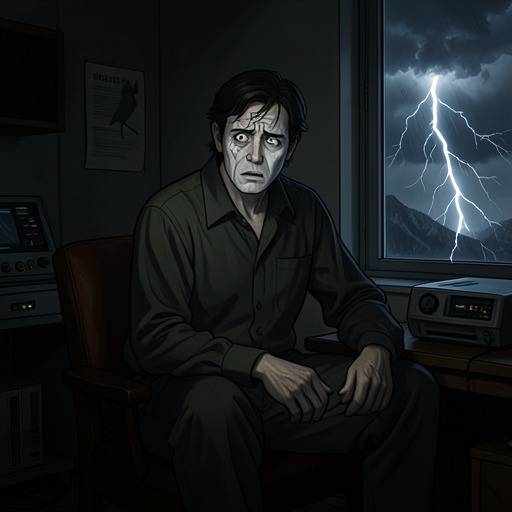
The same tension appears in the book’s emotional weather. A raging thunder exists inside the speaker, accompanied by a tornado of emotions consuming every part of a tormented soul. The Moon’s external light stands opposite this internal storm without resolving it. It gives the turmoil a contrasting horizon: the speaker’s feelings may be violent and engulfing, but the night still contains a visible celestial presence. The Moon’s role is therefore less to end suffering than to make endurance, distance, and partial perception imaginable.
The Moon as a Poetic Structure
The Moon is also connected to the work’s treatment of language itself. Moonlight accompanies monologuing, while the dream of the Moon landing is articulated through a sequence of extraordinary images; elsewhere, “Poetry” and “Words.” are repeated until verbal expression becomes almost material. The Moon belongs to this same poetic process. It is a location that cannot be reduced to geography because it is reached through recollection, fantasy, and verbal patterning.
Its appearances create a movement from possession to distance, from shared speech to silence, and from darkness toward a light that remains partly hidden. In that movement, the Moon gathers the book’s central contrasts without becoming a simple symbol of salvation. It is intimate but remote, luminous but obscured, and associated with renewal precisely because it can be reached only through imagination. As a recurring location, it gives the fragmented emotional landscape a stable point of orientation: the speaker may be surrounded by silence, danger, and inner thunder, yet the Moon continues to offer a visible, unattained elsewhere.